
1. How a 2D LiDAR sees people
A 2D lidar sweeps one flat laser plane through 360°. It has no vertical field of view like a camera, so the mounting height and tilt alone decide where people are detected.
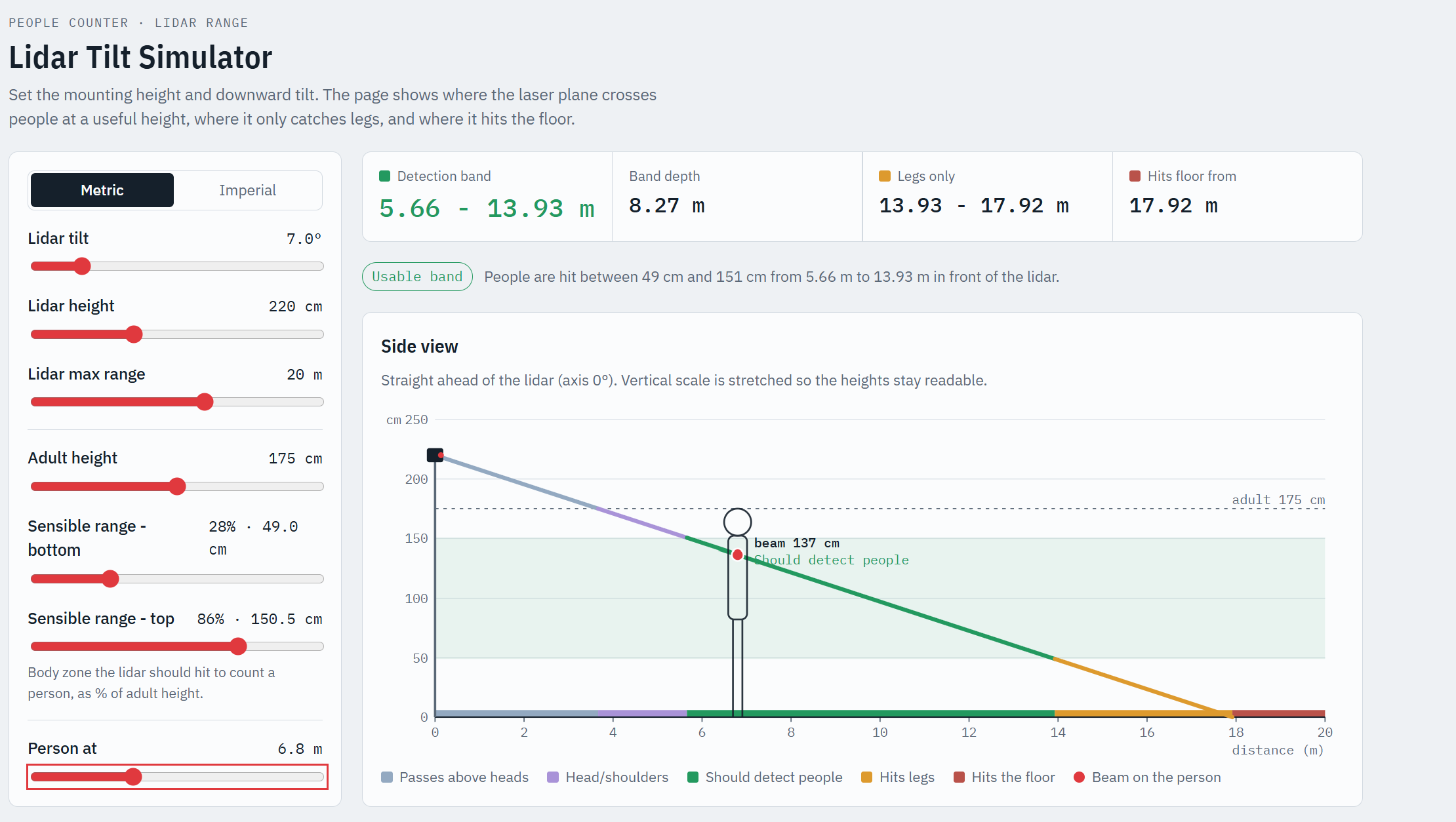
A person is counted where the plane crosses their body between knee and chest height, about 80-150 cm. Higher up, the beam passes over heads. Lower down, it only catches legs, then hits the floor.
2. Hardware and Vidireports setup
- Connect the LiDAR to the computer using the USB cable
- We support 2 models:
- LD19 (can be found here) - 12m detection distance
- L800 (can be found here) - 20m detection distance
- We support 2 models:
- Access the control center using Chrome or Edge: https://localhost:9443/ then login using “admin” & “secret”
- Switch the Mode to "Audience by Lidar":
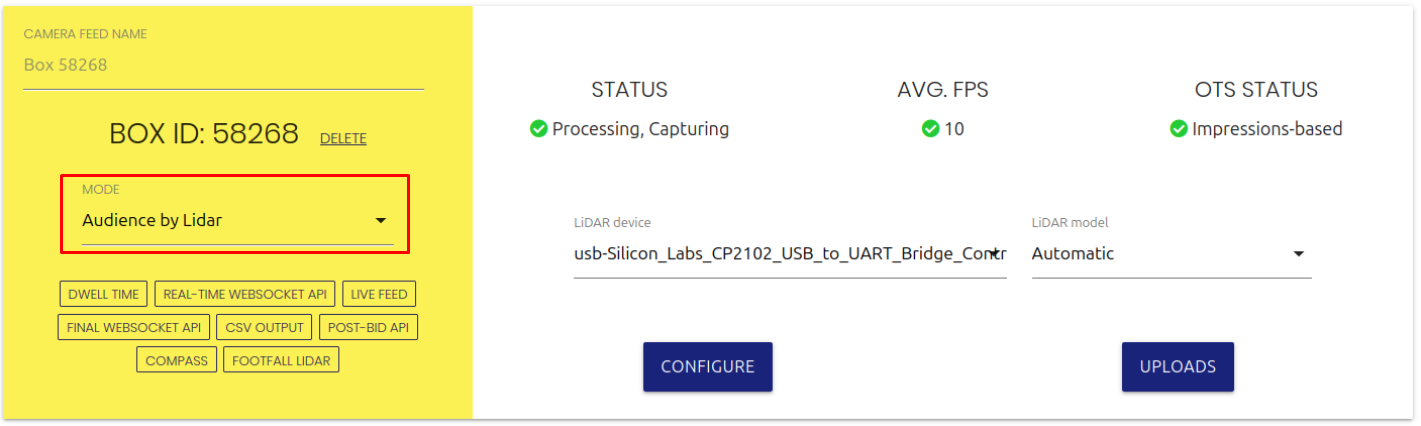
If the LiDAR device is empty, you need to install the LiDAR drivers:
- Go to https://www.silabs.com/developers/usb-to-uart-bridge-vcp-drivers?tab=downloads
- Download and install "CP210x Windows Drivers"
- Restart Vidireports
Note - Make sure to use a USB cable that is fully wired for both power and data. Some cheaper "charge only" cables won't work.
3. Height and tilt
If you can, mount the lidar level (0° tilt) at 100-130 cm, where it detects people over its whole range. If it has to sit higher, tilt it down slightly. A few degrees is enough: a steep tilt such as 45° shrinks the detection zone to less than 1 m.
Lidar height | Suggested tilt | People detected |
|---|---|---|
100-130 cm | 0° (level) | Whole range, up to about 12 m |
180 cm | 7° | 2.4 to 10.7 m away |
200 cm | 7° | 4.0 to 12.3 m away |
220 cm | 7° | 5.7 to 13.9 m away |
200 cm | 10° | 2.8 to 8.6 m away |
220 cm | 10° | 3.9 to 9.7 m away |
250 cm | 12° | 4.7 to 9.5 m away |
For any other setup, check the detection zone in the Lidar Tilt Simulator (attached HTML file).
4. Placement recommendations
Mount the lidar outside the enclosure if you can, with a clear view of the area to measure.
- glass cover precautions: if you place the lidar behind (possibly smoked) glass or acrylic, ensure that the glass does not act as a mirror to the laser beam. This configuration will only work if a tilt of 7° or more is applied.
- Keep it level side to side: only tilt it forward. Any roll makes one side of the scan hit the floor sooner.
- Use a rigid bracket: vibration or a loose mount moves the scan plane.
- When possible, avoid direct sunlight and shiny surfaces: mirrors, polished floors or glass walls in the scan plane can create ghost targets.
If it has to go inside the enclosure:
- Open a slot: cut a horizontal opening along the scan plane, wide enough for the angle you want to cover. Leave a few cm of margin above and below the beam.
- Keep the normal tilt: use the tilt from the table above and cut the slot to match it. Do not tilt the lidar steeply just to see out of the camera hole.
- Put it close to the opening: the closer the lidar is to the slot, the less of the scan the enclosure walls block.
- Cover nearby metal: line the inside surfaces next to the beam with matte black, non-reflective material to cut reflections.
- Test with nobody in front: the lidar also scans the inside of the enclosure behind it. With the area empty, the count should stay at zero.